Showing posts with label International Law. Show all posts
Showing posts with label International Law. Show all posts
Thursday, December 31, 2009
Serbian Nationalists and Karadzic
It's no surprise that Serbian nationalists believe that the Hague ICTY is incapable of providing Radovan Karadic with a fair trial. That said, the trial is going forward. One of the most recent developments concerns Karadzic's attempt to sack his court-appointed attorney. Karadzic is doing everything in his power to delay the trial, and continues to insist that he is innocent on all 11 counts of war crimes. His most infamous act was to oversee the massacre of Bosnian Muslims at Srebrenica. Karadzic continues to argue that war war was avoidable and that Alija Izetbegovic as well as foreign (German) interference was largely responsible for the outbreak of war. Also, there's no denying that the origins of the conflict are difficult to unravel. Still, this trial is not ultimately about establishing blame for the outbreak of the war. Karadzic needs to stand trial for specific war crimes.

Thursday, January 15, 2009
It's not Abuse, it's Torture
Dahlia Lithwick and Phillippe Sands of Slate argue that Susan J. Crawford's explicit use of the word "torture" this week "changes everything". Put simply, the Bush administration has long asserted that a combination of coercive techniques it approved in the wake of 9/11 are legal. Of course, that's because the administration relied on its own lawyers to redefine precisely what torture is. For example, many of the techniques that our military and CIA interrogators have used over the past 7 years mirror those of their former ideological foes, the Red Army and the KGB. Lithwick and Sands state that Crawford's acknowledgement of our activities as torture is "astounding". "She has repudiated the formalistic (and perennially shifting) definitions of torture as whatever-it-is-we-don't-do. She has admitted that there is a medical and legal definition for torture and also that we have crossed the line into it." Who is this Susan J. Crawford? None other than the former "general counsel for the Army during the Reagan administration."
Sunday, January 11, 2009
Torture and Abuse in Our Name
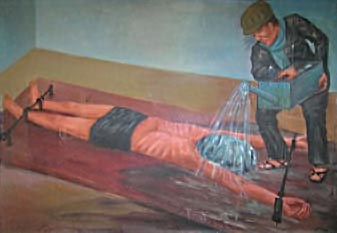
What should do about the actions taken in our name? For the past seven years, our government has been engaged in torture (described by Human-rights advocates as "White-Torture"). What should be done about it? Here are three opinions on the matter. What do you think?
A former prisoner's painting of his torture by the Khmer Rouge in Cambodia.

Wednesday, January 7, 2009
Criticism of the ICTY in the Hague
Marko Attila Hoare's essay (12/24/08) is highly critical of the International Criminal Tribunal for the former Yugoslavia. He compares the course of its trials to those at Nuremberg following WWII, and concludes that the "difference in aim and organization" between the two insitutions explain why one was far more successful than the other. The ICTY, in his opinion, has proved "toothless" because it sought reconciliation rather than justice. This, in turn, has been the result of the international community's failure to "impose a narrative" assigning blame for the "War of Yugoslav Succession". Ultimately, all sides feel simultaneously victimized and vindicated. "There is a lesson to be learned from the respective experiences of the IMT and ICTY: so far as war-crimes are concerned, there can be no real justice without the real defeat of the perpetrators."
Friday, December 26, 2008
Ach! Piraten!
 Somalia: The Germans fought with pirates on Christmas Day! So far this year, there have been 110 pirate attacks in the waters off Somalia. The international community has yet to come up with a viable response to these attacks. Douglass Burgess, in a strongly-worded op-ed piece in the New York Times, argues that legal issues are quickly cleared up if we turn to the ancient Roman solution and declare them "hostis humani generis" or "enemies of the human race". For those of you interested in international law, this is a choice topic. Another important aspect of this story concerns the relationship between the Somali pirates and coastal communities. Somalia's economy is medieval (much like its semi-feudal, warlord dominated politics), and piracy is providing for Somalis. Pirate "revenue" is more dependable than that from coastal fishing.
Finally, The Economist reports that the same lack of a central political authority that makes Somali piracy so difficult to curtail has provided an opening for radical Islamist terrorists.
Subscribe to:
Posts (Atom)